

The echoes of the Jungle
21.06 – 04.07.2026
Costa Rica is a country with a mindset that sets you at ease. People are friendly and the first thing you will see upon landing is their saying Pura Vida. They literally say this instead of hello, goodbye and pretty much for anything. They say it and it means they don’t think you evil and if your outlook to life and your whole nation is to be helping each other and be happy, then you are happy. You may not be rich, but are definitely happy. Happiness, after all, is a mindset. This is my own truth about it and yes, there are hard moments i everyone’s life, but if you choose to see the positives about every hurdle, it’ll be easier to overcome and you’ll be in a better mental state. But enough philosophy, let’s get onto travel stories!
Costa Rica was a trip we planned with my friend Radena and her mom shortly before it happened and since I had already booked my, sort of, long yearly trip, but I have a problem of not being able to say “No” to travel invitations, we discussed that we’d at least try to make it budget-friendly. Well.. that was one giant failure 😀 But I never regret spending money for travel. Money is а “renewable” resource and you will earn money again, but memories are priceless. Soooo we sat down and planned our trip sometime in April or May and decided kind of what we wanted to see. Of course, Costa Rica is a country with insane biodiversity so there, we mostly wanted to see wildlife and birds. Originally, we planned having this trip to be Costa Rica and, since I wanted also something more on the history/culture side, we wanted to combine it with Peru. Especially since we’d be going on a super long flight. However, at the time of planning, we didn’t have that long of time and days off, so 2 weeks Costa Rica only was the plan.
So the plan was ready eventually, we booked everything. A surprising addition (unpleasant), was the prices of the private drivers to pick us up, drive is to a national park, wait for us and drive us back, for amount varying between 200 and 400 USD for a single day. I don’t know if that is too expensive, or is a normal price because in Costa Rica go mostly American tourists with the “big bucks”. For me that’s a little on the high end especially given that I sort of, ignorantly, expected the country to be a rather poor country and standards a little lower (no offense) and therefore cheaper prices. Well that happened to be quite the opposite. And yes, the majority of people live in a pretty modest type of homes, foreigners seemed to be owning the large brick or panel-like buildings with big fences, but that was definitely what the prices reflected in the supermarkets, tour guide fees, driver fees etc. The only thing that kind of matched that expections was the entries to the national parks which were around the 10-15 USD per person. But we went inside the supermarket, got water, some basic food (bread, salami, cheese spread, drinks), and some fruit and sweets and would exit with a 150 eur bill super easy. I am not sure, reading the average salaries, how do these people afford food. Maybe they go to markets, not sure. If anyone knows, let me know!
Day 1: The Toucan Rescue Ranch & San Jose city walk
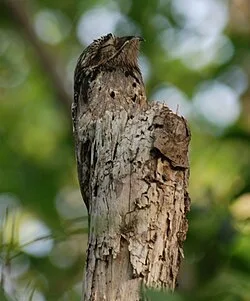
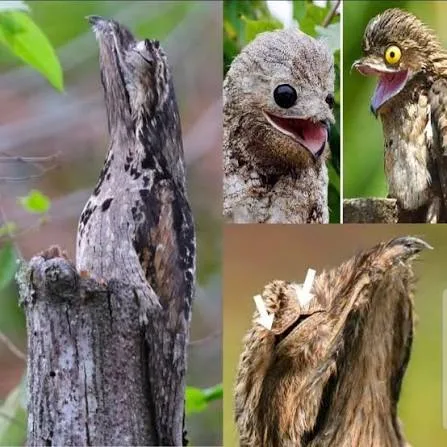
So i flew into Costa Rica directly from Amsterdam. Super lucky to have a direct flight since Dutch people love going to Costa Rica and it’s quite a famous destination for them. Lots of people around me have mentioned going there recently, incl. my work’s PM who was there for his honeymoon in February. He later on told me they also went to Tortuguero where there’s also a turtle conservancy center. Apparently they managed to see a turtle, although not there. When we were researching, we decided to skip it since, according to our research, the egg laying season would begin about 1-2 weeks after we leave so we figured, we’d only stay at the Pacific coast and not go to the Caribbean coast where Limon and Tortuguero are. Later on I also discovered that the Macaws are split also between the coasts wich the red/blue ones in the Pacific side and the Yellow/Green ones on the Caribbean coast. We onlt saw the first one. So I arrived at Costa Rica just one hour before the flight of Rad and Toni. Such a great sync of fights. So I picked my luggage and just sat down to wait for them to arrive. When they did, i picked their luggages while they were at the passport control which took them a looong time as opposed for me – i passed directly for like 3 min and there was someone available to check my documents. When they arrived, we walked outside and up a bridge to go to the Departures area which was on the first floor, that’s where the Uber drivers would come to pick us up. So we ordered an uber. We arrived at the Autentico hotel – the room was pretty spacious and quite nice. Giant king beds on which we had more than enough room, AC, dining and sort of living room table and bench-like thing. Enough room for all of us. The area was close to a supermarket but not very safe in general at night, which is a classic issue in San Jose, apparently. So they warned us if we go smoke outside (Toni smokes), to go to the parking area which is not too obvious from the road. The issue is that muggings can occur and Costa Rica is on the “highway” of the drug smuggling from South to North America. So it is generally not super safe, but we didn’t have any issues, so one should exercise vigilance and everything should be fine. We took room services once and once ate at the restaurant. So the first real travel day, started the next day when our tour guide who was going to bring us around for the next 3 days, picked us up and off we went to the Toucan Rescue Ranch where we wanted to see well.. Toucans but also sloths. This is a rescue center that heals and rehabilitates animals brought to them and the ones that cannot be released, they take care of there and these are the “ambassador” animals you could see. By going there, you basically donate to them and help them help animals. They have a “classroom” where they tell you more about the animals and the center at the start of your tour and you can only go see the animals with a guide, never alone. I tried to pick a fallen feather from one of the macaws, outside of the cages and they asked me to not do it since it may encourage other people to try to harm birds to obtain one too. It makes sense and I left it there. There is a section of the rescue, which you can walk to and another where they keep the “releasable” animals away from people and in general caring for them with as little human interference as possible, so they can indeed be released back asap. They had several two-toed sloths (the cappuccino coloured ones, I love them, such gorgeous animals) but did not have the three-toed ones, these are the ones that look like as if they are smiling, grey in colour. Apparently sloths are sort of a breeding ground and “habitat” for more than 50 different bug species that live on them all the time which is quite fascinating but a good reason you wouldn’t want to touch them as cute as they look. Also as slow as they look, when they are in a rush, they can be significantly quicker in their movements and I saw this with my eyes at a heavy rainfall for three-toed sloth later on in our trip. I will tell more about it at the relevant place for it. Also sloths generally don’t come down from the tree canopy ever, only once a week to do potty on the ground and then go right back up. This is also the moment when they are the most vulnerable to predators. Predators of sloths are jaguars, ocelots and other cats, they did also have an ocelot at the rescue center as well as jaguaryndy – a tiny jaguar-looking wild cat. I loved seeing these awesome animals. And the birds are what I went there to see also. They had a pootoo – the frogmouth bird that during the day stays erected on dry tree logs effectively “extending” the logs and blending in to the point of becoming absolutely invisible unless they move to make you notice them. Such an amazing bird.
What was an awesome surprise, was a beautiful Toucanette that came to visit one of his friends who was in a cage unable to be released. Such a sweet bird and sooo gorgeous. It was the fiery-billed acari. In Costa Rica I was constanty, literally, constantly recording bird sounds with the Merlin Bird ID app just like years ago I was collecting Pokemons 😀 Pretty much the same, but REAL and so joyous 🙂
However, it was not all rainbows and sunshine and there was a very sad barn owl that was hit on the head by a villager who wanted to kill it due to superstitions people there have when it come to owls. We have them also in the rural Bulgarian villages and it is maddening to see people harm gorgeous AND SUPER useful birds lile owls back home, or in Costa Rica. The bird survived but was suffering neurological issues and who know if it will recover and how long it will take. Of course, they had so many animals, I will add plenty of photos for every part of the trip but at the end of the day, I also saw my first collibri! (hummingbird.. sorry, that other one was in Bulgarian). It was soooo cute, and little did I know how many of them I would see the days to follow. My trip goal was to see sloths, toucans and hummingbirds, and quetzals. Everything was going to be a nice added bonus. And I saw almost all of them on my first day! Then I could just enjoy the rest of the trip and only try to find quetzals. Spoiler.. we never saw one 🙁
On the way back, we asked our driver to drop us in San Jose, where we walked the city center, explored it a bit and had some dinner at a fast-food restaurant. There were many parakeets in the city and the sad part – so many stringfoot pigeons 🙁 I wanted to cry and surely could lure and catch a few of them and try to remove the strings had I brought any of my pigeon tools 🙁 But I felt so bad that I left Rad and Toni to eat and I went to look for a small sharp pair of scissors to the local pharmacy, a supermarket and a few other stores and they didn’t have these things at all 🙁 I felt really bad for not bringing my tools, there poor birds were suffering so much 🙁 If you care about them and happen to travel to San Jose, please bring tools and help some poor little PG souls if you can. Anyway, we then went to some book stores, I got a few books, each was at least 20 eur (a tiny bird-list of like 5-6 pages), one was 40 eur (crazy prices) but I god my books nevertheless, that’s part of my “souvenir” collection and it adds up to my fav book library at home, so not regretting! We then took another uber and went back to our hotel, had dinner at the restaurant and went to sleep. Our pickup the next day, was for 5AM.
Day 2: Monteverde Cloud Forest & Curi Cancha NP
When our guide picked us up for the first 3h drive day we wanted to pass by somewhere first to have breakfast. And he knew the best places – roadside restaurant of the buffet type where you can choose what to get and you can get only just fruit if you so desire, or a full-blown brunch. We, ofc, went for the latter 😀 And as much as I always say I have no breakfast usually, it is also hard to control myself knowing that I may or may not have another chance for many hours AND on top of that, I see all these super delicious cooked meals and I just cannot say no to. Not only that, but I filled my plates to the brim and ofc didn’t finish them.. surprise surprise. They seem to eat a lot of rice with black beans, this is what our guide ate every day plus some meat and some other extras. This beans and rice meal is called Gallo Pinto. I always tried to eat as fast as possible and then went outside of the restaurant to watch for birds while the rest were finishing up. Also because sometimes I’d want a bit of a me-time, just to observe and let the scenery sink in.
The road towards the Monteverde Cloud Forest was about 3h and went through such beautiful scenery crossing mountains and seeing the fog in between the jungle trees. This view has always mesmerized me, I couldn’t stop trying to take pictures knowing none of them will be successful, but that didn’t make me stop trying. Anyway, we asked the guide to stop somewhere on the side of the road so we can take in the scenery and take a few proper photos. So he found a nice spot, it was also nice to stretch our legs a bit. And there were vultures flying over, which, of course, made me super excited 😀 So eventually we arrived at Curi Cancha, it is basically Monteverde, but more at the base of the mountain, but still we read that this is an excellent spot for birding and so we planned to be there early to catch the morning bird hustle. We spent there maybe 2-3h, slowly walking around, there was one of these gorgeous jungle trees, the Kapok tree with roots giant like walls and on the other side of the tree, you could even kind of go into it as if you go into a cave. We strolled around the jungle, explored the rose garden and found a nice pond area where I observed some birds flying around. Then, as we walked, there was a bush with flowers and I thought I saw a hummingbird. I got sooo excited and then realized that.. it’s FULL of hummingbirds, OMG! It was THE BEST. I found a hummingbird sitting on a branch soo close to me, I managed to make the best hummingbird photos in the world! Just LOOK AT THIS!
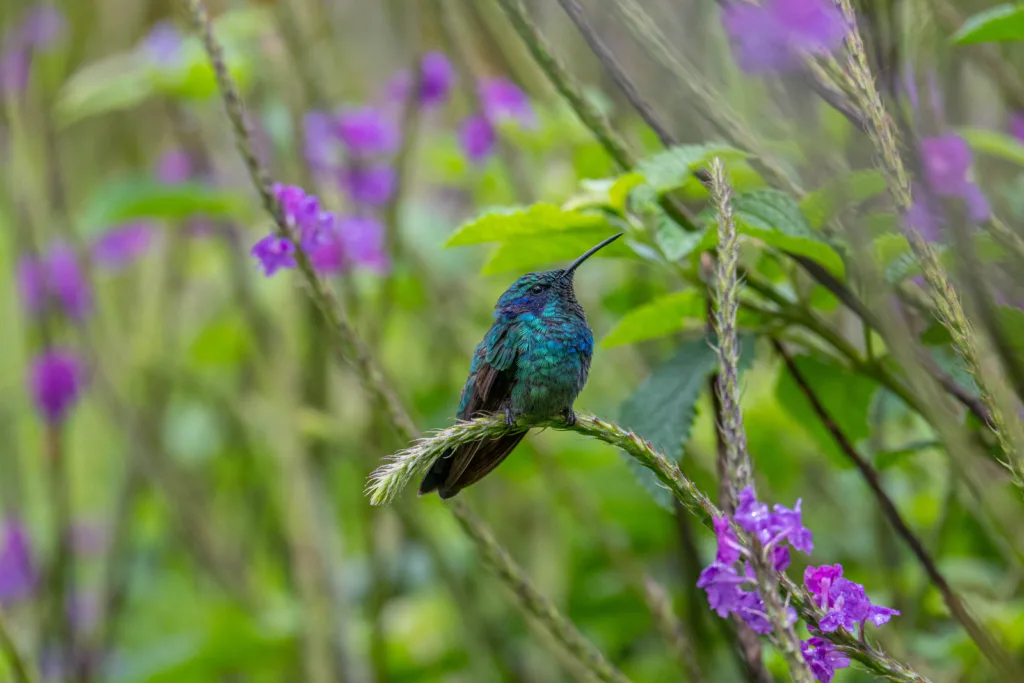
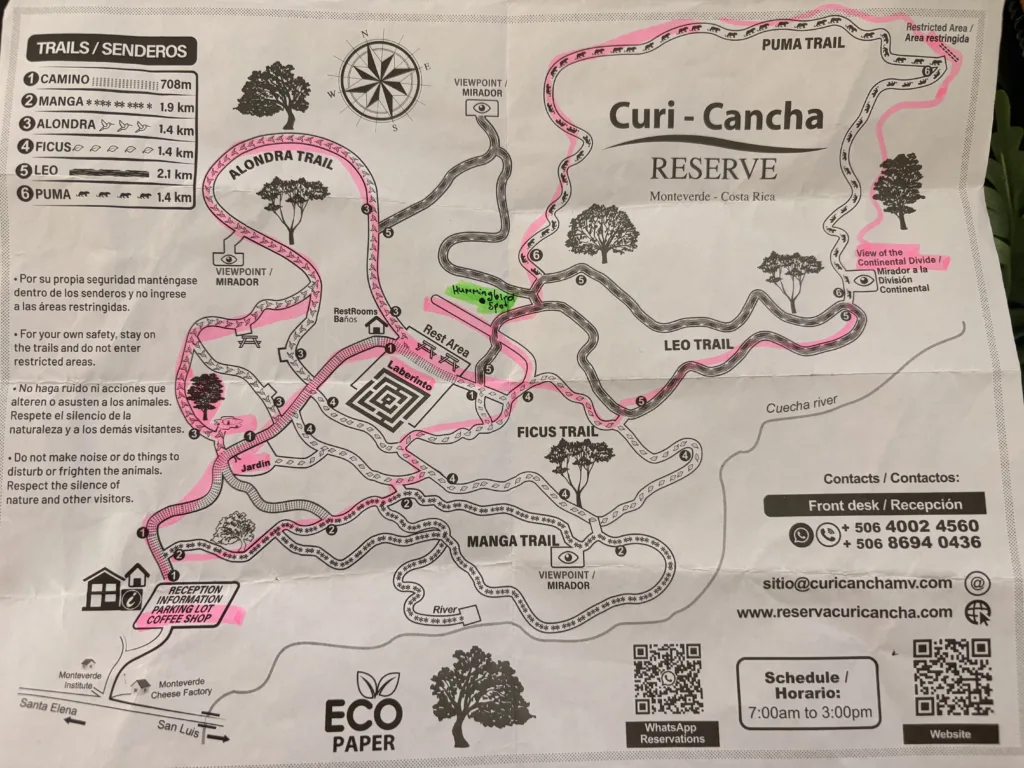
At the entrance of Curi Cancha they drew a nice path for us to walk on the map (below) so we can see the whole part and highlighted that the Puma Trail is the steepest but also most scenic and with chances to see maybe some Quetzals so I was very eager to go there, however we didn’t have enough time, our pace was rather slow, as we wanted to enjoy it and eventually we only did the Jardin, then continued on road 3 (Alondra). The Alondra trail, particularly after that big Tree shown on the photo right after the Jardin, above it there’s a little bench icon, right before that bench were the bushes where I saw all the hummingbirds. I saw at least 2-3 different species of hummingbirds there that I took pictures of. I was so excited that I spent quite some time, it was my first time properly seeing hummingbirds and I was waay too excited, forgot about quetzals and all. Eventually, we continued along the Alondra trail and we turned left on path 5 (Leo). We reached the Mirador viewpoint and then Rad decided to go back to the rest area (next to the Labyrinth) where Toni was, and I took left to proceed towards the other part of the Leo trail as I hate doing a path twice, especially if it’s a new place i’m exploring. So I continued and turned right and was walking towards the rest area too, but then as I was passing close to the green marked area – it looked form the distance as if there’s a rest ara there too, but you couldn’t see anything else. It’d be super easy to miss it. But i thought, “Let me quickly take a look”. OMG and I DIED! It was FULL, literally FULL of all sorts of collibris! I remember almost wanting to scream of excitement. I took my camera out and just couldn’t stop taking pictures, all sorts of birds – tiny, bigger, even bigger, all hummingbirds, but there were maybe 6-7 feeders and they were ALL occupied by birds, it was AMAZING! I think I spent 15 min there, I was in a rush because I didn’t know if they would look for me and we had other plans etc, so i had to rush which i did NOT enjoy, but it was a bit self-inflicted rush. When I found them, they weren’t so much in a rush, although ofc we wanted to have enough time for the suspended bridges of Monteverde which was the main thing we were going there for. So we went to Monteverde next.
It is an important nature reserve, rich in biodiversity. Back in 1972, scientist George Powell became concerned about deforestation and hunting in Monteverde and joined forces with local Quaker Wilford Guindon to establish a nature reserve with the Tropical Science Center. Starting with 328 hectares of donated land, the reserve grew with support from donors and conservation organizations. A 1977 BBC documentary brought international attention to Monteverde’s cloud forests. Along with organizations like the World Wildlife Fund, Nature Conservancy, and BirdLife International, it expanded and now protects 10,500 hectares of forest!
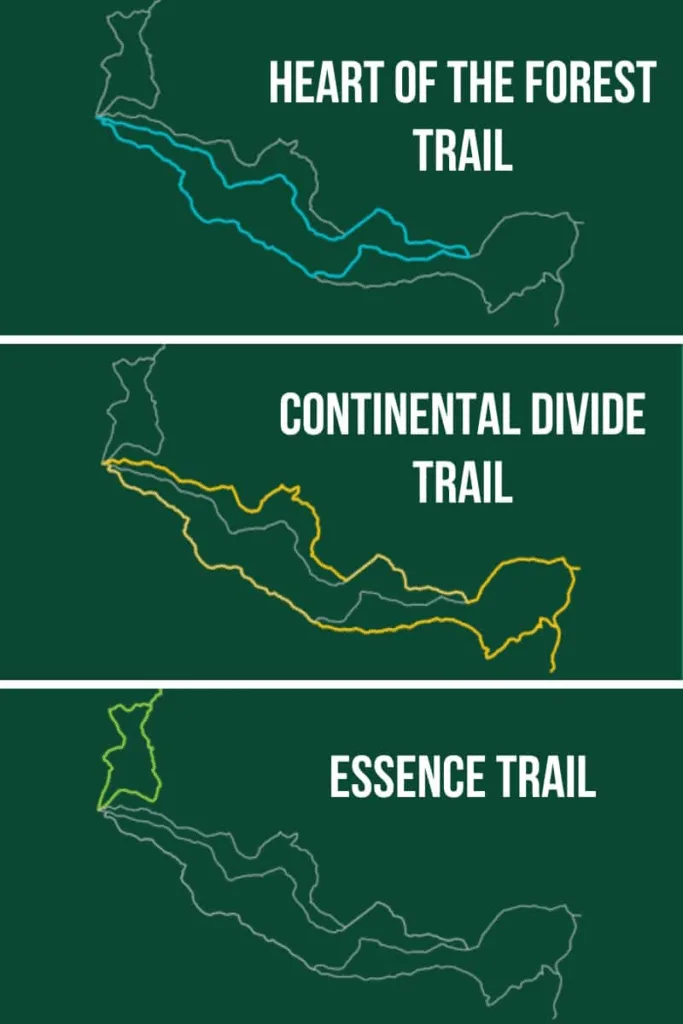
When we walked the Heart of the Forest trail towards the suspended bridge, we really enjoyed the rich vegetation. I walked behind them or way ahead of them to try and record a little bit of the forest for a soundscape. I also wanted to enjoy the scenery on my own and build a memory, so I would stop and just stare at the trees, and listen, and let everything around me sink in.. and then a group of people would come.. and ruin it all 😀 Well.. too bad. The bridge was suuper awesome. We also saw a poor little creature, a coati, which came down a tree and we stood still, it headed right in front of me and passed by me super close, like 30 cm distance or so, but it was hurt and couldn’t step on his front left paw 🙁 I hope it has healed since then, but in any case, it managed to get down and up the trees, so I hope it will survive. We also saw agouti. Sort of a capybara cousin 😀 or so it looks like. Suuper cute creature.
Day 3: La Selva Biological Station & Braulio Currillo NP
Braulio Currillo features an aerial tram – sort of a cable car but open, through the forest. We really wanted to see that and it was planned for our first day, however having a private driver paid back here because from his colleagues he heard on the first day, that on the way to the park there has been a mudslide which happens rather often in Costa Rica unfortunately and that had caused road closure. So something that would normally take 30 min drive, would have taken us 3h on another road. So we decided to move it to the third day and combine it with the Selva station. So we headed first thing in the morning to La Selva Biological Station. It is a research station where naturalists, botanists, ornithologists and biodiversity researchers come to study the nature of Costa Rica. The species richness of La Selva is outstanding, with more than 2077 species of plants; 125 species of mammals (72 of them bats); 470 species of birds; 48 amphibian species; 87 species of reptiles; 45 species of freshwater fish; and tens of thousands of insects, arachnids, and other arthropods. You cannot enter the part without a guide. The only exception is if you book accommodation there and sleep at the station, then you can explore the trails on your own, but otherwise it is not possible.
The weather that day was more than horrible. Adding to the 100% humidity, was dull, grey weather, with rain. Because of that we had to put on our raincoats and we died of heat. I couldn’t bear it. Add to that a constantly following literaly swarm of mosquitoes, it was literally unbearable. I did spray myself with a shitload of DEET and despite dying of heat, I did not remove my raincoat because i didn’t want to expose my arms to the mosquitoes. And as soon as you stop moving, they start going into your face, your mouth, eyes, everywhere. I’ve never experienced such a horrible thing with these mosquitoes. However, while this was horrible, let’s not focus only on it. Our guide was an ornithologist and he could point out so many birds, I loved spotting birds with him and asking him info on them. Rad also asked him a lot about plants, which is definitely her domain. We saw two species of toucans, monkeys, many other birds, including 2 raptors and a very special snowy tanager which, as our guide pointed, was a super rare bird and an ornithologist had recently been there for 2 weeks trying to spot that bird and we saw it pretty much out of luck. Super cool! We also saw vultures, parrots, and caimans – a mother and her baby caimans 😀 And the giant blue butterfly that I have seen in the Rotterdam zoo’s butterfly area – the Blue Morph butterfly. It was soo gorgeous. It also stayed still on a leaf with the wings not up closed but sort of open, so we could clearly see the blue-coloured wings. The guide said that this is not normal and he would’ve thought that the morph is dead if he hadn’t seen it fly, it is not a typical position for a butterfly.