

Trip plan
I have booked this Madagascar trip which I wanted to do 2y ago, somewhat as a spontaneous thing one late night in January, after looking at trips for 20 min, I found this 24 day tour and after careful consideration of another 20 min, I booked it. Madagascar was on my list for a veery long time due to its endemic flora and fauna, the species of Baobab trees and the numerous lemurs, frogs and chameleons that you can only see there and nowhere else in the world (in their natural habitat). And this trip had it all (almost), except the Aye-Aye lemur habitat to the very South and the Red Tsingy in the North. So I went ahead and booked it. The route was as follows..
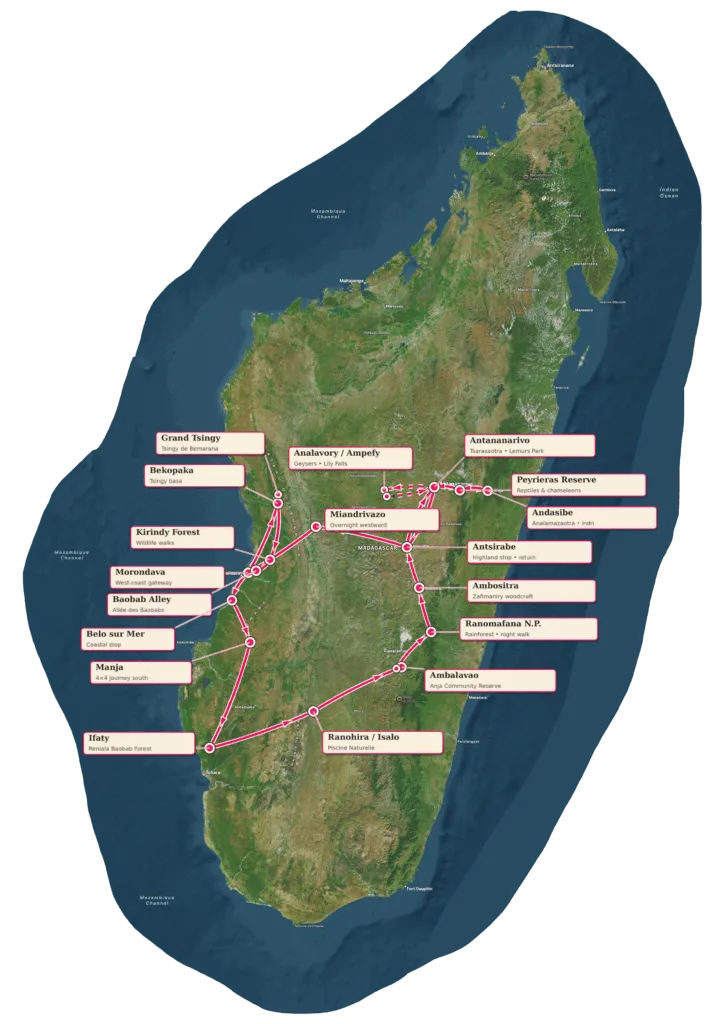
Days -1 to 1: 06-07.10.2026 – Flights to Antananarivo
Sooo I am writing this from the bus in Madagascar on the first real day of the tour. Let’s just say it was an experience to get to Madagascar… We flew off with Kenya Airways, our flight arrived in Nairobi at 6 AM and was supposed to leave at 12ish but it got delayed to 16h, then to 16:40 which is when it finally left. But guess what happened – my luggage and one more woman’s luggage didn’t arrive. There were at least 10 more passengers whose luggage didn’t arrive. I think I won’t be using Kenya Airways anymore. We had to go last night at 2 AM to the airport to see if our bags arrived with the next flight and I heard that they didn’t even know that some bags were missing.
So they didn’t arrive, they were not loaded onto the plane. So now we are on the way to Antsirabe and the latest update is that the bags should arrive on Sunday (today is Friday). Somehow I had a gut feeling that this time I should get some underwear in the handbag and luckily I did that so I had underwear for 3 days and socks for 2 days and had to start washing. I bought also a T-shirt from Nairobi airport so now today I am using it and have no other T-shirts. So now we have to go do urgent shopping, I hope the insurance will reimburse these costs. I have just bought cosmetics like shampoo, conditioner, toothpaste, 2 pairs of underwear, 3 pairs of socks, some feminine products, washing powder, disinfectant etc.
What I am mad at myself about is that I didn’t have space for my sound-recording microphone and didn’t take it in the hand luggage so now it’s lost along with some previous recordings I had on it which is a big failure. Also my flat iron, and some of my favourite Blakely clothes – 2 pairs of leggings that I absolutely love and the hoodie. Such a shame. And normally I would put a GPS tag inside the bag to keep track of it but this time I forgot. And I had a very nice thick hoodie for when it gets cold and a super nice raincoat that I found and it was a total gem and I love it. So I will definitely file a claim if the bag doesn’t arrive at all.
So the rest of the shopping includes buying new malaria pills since all of mine are in the bag, some more general medication, and some clothes – T-shirts, shorts, pants etc.
Day 1 – 08.10.2026 – Antananarivo
But after a bumpy start, I am trying to think less of that and more of what’s ahead. So we had a free day yesterday until the full group gathers and I had booked a private driver and a tour guide to bring me to the Tsarasaotra Bird park, to the Queen’s palace and to a rescue park for Lemurs. It was amazing. But before I go there, I want to talk a bit about the culture shock. Madagascar has 32 million people, the population grows 2% per year. They produce and export nickel, titanium. They export vanilla, then cloves, titanium and then clothes out of cotton.
They also export essential oils, we will be seeing a distillery of essential oils. They export also fish and shrimp and prawn and cacao beans and also some cobalt is exported from the mines underground. But per capita their GDP is only 600 USD per year. So you can imagine it is one of the poorest nations. And this is clearly visible when you drive around the city.
They import petroleum, water and salt from Europe and despite all of their rice fields, they also import rice, crude palm oil, raw canned sugar, and second-hand clothing. But the poverty is striking. Most of the population is young. They have no jobs, yes they work on the rice fields, but survive with about 2 EUR a day, sometimes they don’t eat at all. You see lots of mothers and kids in between the road’s lanes and their infants begging for money. Or mothers who made something like postcards, they chase you begging you to buy something. One mother with a child saw I bought something and insisted that I buy from her cards too, they were beautiful but I already had bought some cards. But she had an infant and said she needs to feed it so…
I bought one more stack of cards. I suppose this time I am giving away cards instead of magnets to my friends. Another thing that surprised me is that they carry heavy things all day long and they use a sort of carriage where you’d normally have a horse to pull it but they have no horses, so actually people carry them themselves, often one pushing from the back and one pulling. And they carry super heavy things. Also on top of their heads, that seems to be a skill every Malagasy possesses. It is so diverse. As we drive I am observing the people, because the first settlers on Madagascar were from Indonesia and Malaysia and later came the more African nations too. So people are so diverse and you can see people that are more Asian looking or more African looking or a mix.
It is super interesting and all people are extremely friendly, super polite and smiling, kids waving at us, they are just too cute. And a group of young girls made us laugh because they first waved at us and then one of them showed us a middle finger and then giggled which was so funny because she seemed embarrassed but knew ofc we can’t do anything about it haha.
So the first day I had a booked trip to the Tsarasaotra bird park, it is privately owned land and a lake with thousands of waterfowl and other birds, lots of egrets and all sorts of ducks and other birds. I had specifically requested not to have a guide in there and only in the city centre but he was waiting at the gate when the driver and I arrived. So instead of having a chill walk watching the birds, I had to entertain the guide and couldn’t really enjoy my time that much and had to rush. So I may go back the last day in Antananarivo, since now I have a late flight. I might as well book a driver to bring me and wait for me. And I can be there from 6 till 8 or so. Take my time and walk in quietness and just enjoy the birds and the sounds.
We were done with the park maybe 1.5h later and then we left for the center. We went to the Queen’s palace. The guide told me about the first king of the country who wanted to have more connections with the British and the French which he did. But eventually he died and his wife became the notorious “mean” Queen Ranavalona I. She absolutely hated the Brits and French and also Christians and was killing them every chance she got. She also had a lot of lovers and whenever she was not happy with them, she would throw them from the hill. She also didn’t spare her own people along the way. Horrible woman, she is considered one of the cruelest rulers and it seems that Queen Victoria later on was described in a similar way as Ranavalona I in terms of her cruelty by some British authors, creating the current image of her. Also nobody knew who the father of her son Radama II, who became the second king, was, whom they call a real king because he actually united the tribes of Madagascar into one country and ruled over them. Radama II rejected his mother’s policy of isolationism and persecution of Christians and permitted religious freedom and re-opened Madagascar to European influence. During his mother’s reign, he secretly set a contract with the French giving them exclusive rights to the exploitation of large tracts of valuable land and other lucrative resources and projects. This was later terminated by the first Prime Minister but it was the reason France declared Madagascar as a colony later on in 1896 until their liberation in 1960.
At the palace was interesting to see that the royals, apparently, were short. At the palace you can see the beds and clothes of some of them and the bed of the second queen or so was so tiny I thought it was a kid’s bed. So after the second queen and onwards, Madagascar wasn’t exactly a kingdom anymore and had a prime minister who would marry the second, third and then the last, fourth queen, who ruled for a very short time before she was banished out of the country. Her remains were later returned to the family tomb at the palace where there is one tomb for the kings and one for the queens. Placing remains in a tomb is how Malagasy bury their dead. Even nowadays for a rather small village you will see 2, maybe 3, tombs where they bury their dead for several generations of the same family, so they are all together.
Some tribes practice a tradition which comes from their Asian roots, where after 7y they exhume the body of the dead, make a feast for the whole village, sacrifice one or more zebu cows for the feast, rewrap the dead in clean cloth or clothes and bury them again, this is how they show their respect to their ancestors. It is a happy thing for them, they practice that same tradition in Indonesia as well.
Another thing the guide told me was about the pedestal at the front of the gate – it’s a penis to symbolize the man and nothing on the other side… to symbolize women. In Madagascar it is required for boys to go through circumcision, or an incision and removal of the foreskin on the penis. This is a ritual that is held once every 7 years and all young boys go through this procedure. Now… the following may be a bit disturbing but… gonna say it anyway, it is an honour and a symbol of a great bond that when the skin is removed, the grandfather of that boy would eat it with some banana or other fruit. It is something that is followed as a sort of tradition in the tribes.
Anyway, after the palace, we parted ways with the guide and my driver and I went to the Lemur Park. At the park you cannot go alone, but always have to go with a guide since this place is a rescue center where they help animals and return them to their native habitat. The park didn’t exist until 25y ago and was made for the lemurs on a hilly location, bordered by the river, planted with lots of trees and plants, and fruit trees for the lemurs. It is very lush and beautiful. I saw several species of lemurs there. Lemurs live in a pack of a varied number of individuals based on their species, and the pack stays together until they are too many at which point some females would sort of fight for dominance and one would leave and some of the males will follow her and they start a new pack.
They are soo cool to observe. The park rangers currently supplement 4 times a day with fruit that they cannot find in the park yet, but have also planted those trees in the park but it would be a while until they produce fruit, and enough for all of them. They also have star tortoises, endemic to Madagascar, super big land turtles, so cute! But the most impressive was the screaming and shouting of the lemurs when they got agitated. And they had 4 or 5 different lemur species. I also saw a flying-by hamerkop but didn’t see it very well as it was in between the trees. It was a shame I didn’t see it, I really wanted to.